VALUE-ADDED
Reduce waste.
It is more effective to reduce waste than to fine-tune what already works: there is no point running faster in every direction; better to walk straighter.

A common language for value, flow, waste, the « pull » system, respect, and continuous improvement.
Anything that does not contribute must be eliminated.
Lean starts with what the customer is willing to pay for. Anything that does not contribute to that value is a waste of resources : effort, money, time.
It is more effective to reduce waste than to fine-tune what already works: there is no point running faster in every direction; better to walk straighter.
The people who do the work create the value. They are also the best placed to spot and reduce waste.
Create more value with fewer resources, less waste, smoother flow, and more engaged teams.
What the customer pays for. Clarify with all stakeholders what value is.
By tracing the entire process, identify all activities that do not add value: waste.
Everything that disrupts smooth, even process flow is addressed: waste, overburden, and unevenness in workload. The performance of a perfectly flowing process is optimal.
Doing things at the right time, neither too early nor too late, without wasted time or effort, means working to demand, not to capacity or availability. Matching resources to needs, in quantity and in timing, is essential to deliver the right outcome, at the best cost, highest quality, and with the greatest satisfaction.
Nothing is so perfect that it cannot be improved. Through continuous, very frequent, even small, improvements, we move faster toward the goal of perfection.
Design, coordination, production, and commitment. Projects are not standard repetitive processes: they are prototypes and complex social systems.
Leanfinity helps make this system controllable, reliable, and value-driven by linking Lean methods to real project decisions.
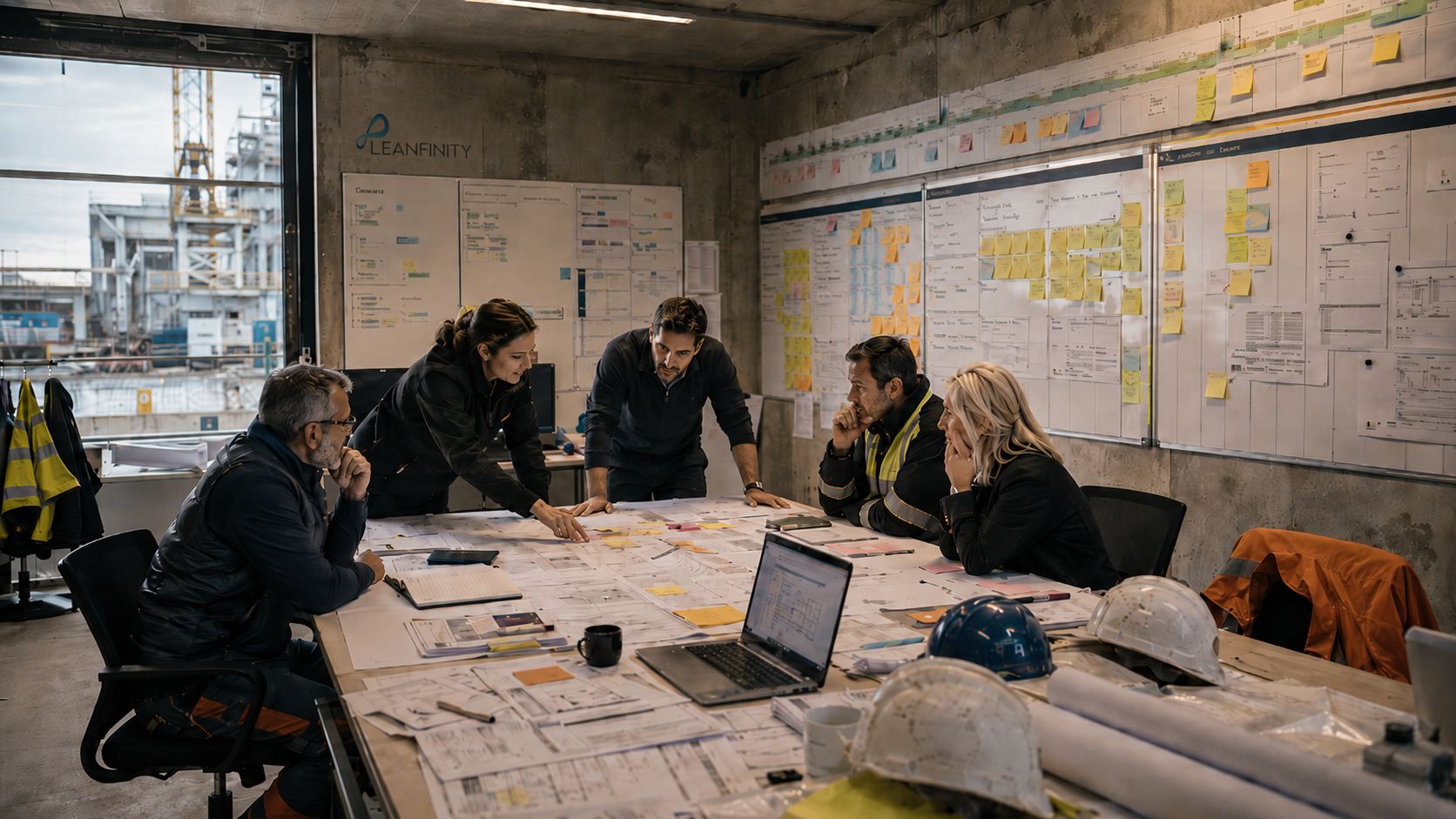
An operating system for projects: collaboration, flow, commitments, and learning.
Turn schedule intent into reliable weekly commitments.
Plan backward from milestones, needs, and the actual conditions for success.
Design and deliver to value, target cost, and project constraints.
Align stakeholders, decisions, risks, and rewards around a shared outcome.
Apply Lean principles to design: information, decisions, deliverables, and constructability.
Lean Project Delivery turns the project into a controllable system: clearly defined value, timely decisions, collaborative planning, reliable production, and continuous performance improvement.
Clarify what really matters to the owner, users, and stakeholders, then make it the guiding thread for decisions, design, and execution.
Build the schedule back from key milestones, clarify interfaces between parties, and remove constraints before they become blockers.
Make execution predictable with clear weekly commitments, PPC tracking, and variance analysis to make commitments between parties reliable.
Learn fast in the field, standardize what works, and adjust practices to drive sustained performance improvement.
Key milestones and the best logical sequence of work.
Tasks that are executable after constraints are removed.
Weekly commitments made by the teams.
Work completed, measured, and used to learn.
The Last Planner System® makes constraints visible before they block production. It stabilizes short-term execution and enables learning from variances without blaming people.
Milestones become coordination tools, not just decorations on the wall.
What needs to be ready?
Who needs what, from whom?
What are the prerequisites to start?
What will each team commit to?
Design and deliver from expected value and target cost, rather than discovering too late that the project no longer fits the budget.
What are the real objectives of the project?
Cost, performance, schedule, carbon, and major constraints.
Explore options, make trade-offs, and estimate continuously.
Make value-based decisions, then capture the learning.
IPD aligns the commercial system and establishes an alliance framework across all stakeholders.
Shared objectives / transparent decisions / aligned risks and rewards
Lean Engineering transforms design into a system of managed decisions: compare before locking, integrate before producing, learn before repeating, and deliver a buildable, operable solution aligned to value.
Define what the solution must achieve for the client, users, operations, maintenance, and the target cost. It is not only about designing an asset, but specifying what must be true at the end.
Identify technical choices that will strongly impact cost, schedule, constructability, interfaces, risk, or operations. An unrecognized critical decision often becomes late rework.
Do not lock in a single solution too early. Compare alternatives against explicit criteria: value, cost, risk, schedule, constructability, operations, and maintenance.
Bring in construction, procurement, means and methods, commissioning, operations, and maintenance before choices become irreversible.
Turn validated decisions into standards, typical details, design rules, reliable information for execution, and reusable lessons.
Trust isn’t a mood; it is built through working conditions, rituals, and behaviors.
Problems detected quickly.
Effective decision-making and escalation.
People commit and learn.
Facts before opinions.
Factories, offices, back office, or services: wherever work repeats, Lean Management simplifies flow, stabilizes quality, and improves performance.
Just-in-TimeThe right item, in the right quantity, at the right time.
JidokaMake abnormalities visible, understand them, and correct them before they spread.
Standard WorkStabilize the best-known method to train, execute, and improve more effectively.
KaizenAdvance the system every day with the teams doing the work.
The goal is not to make each transaction faster, but to make the entire production flow.
Performance comes not from speeding up individual tasks, but from a production system that is flowing, stable, and prepared.
Make performance visible, problems solvable, and improvement systematic.
A shared view of performance, priorities, and obstacles.
Short cycles for alignment, escalation, and learning.
A3 thinking, root causes, experiments, and countermeasures.
Leaders manage the system, not just emergencies.
Observe the system as it is, not as the procedure prescribes.
Information flow also contains waste : loops, queues, unclear decisions, and avoidable rework.
The customer or internal request arrives.
Missing data resolved.
Rules and approvals applied.
Output delivered.
Defects and delays reduced.

AI does not replace human judgment. It strengthens Lean when the process is understood, data are reliable, and decisions are clearly governed.
Meetings, schedules, field reports, ERP, BIM, and IoT.
Delays, constraints, quality risks, and workload imbalances.
Summarize, track actions, compare options, and support decision-making.
Turn trends into standards, guides, and improvement hypotheses.
Minutes, decisions, action owners, weak signals, escalation.
Constraint detection, delay forecasting, workload leveling.
Option evaluation, requirements traceability, design review assistance.
Photo analysis, evidence of progress, quality observations.
Lessons learned, reusable standards and guides.
Start with the process, preserve trust, then develop the technology.
Which decision or flow problem are we trying to improve?
Which sources are reliable, available, and legally usable?
Who validates the outputs and makes the decisions?
Which practices become repeatable after experimentation?
It means ensuring that, on cutover day, the organization, teams, equipment, processes, flows, data, and interfaces are ready to operate at the expected level, with minimal loss of productivity.
Define the event and success criteria.
Plan all prerequisites.
Freeze interfaces and rehearsals.
Readiness checks.
Flawless execution.
Leanfinity steps in when complexity is real, the stakes are high, and the results are non-negotiable.