01 · Why AI becomes powerful when Lean gives it purpose
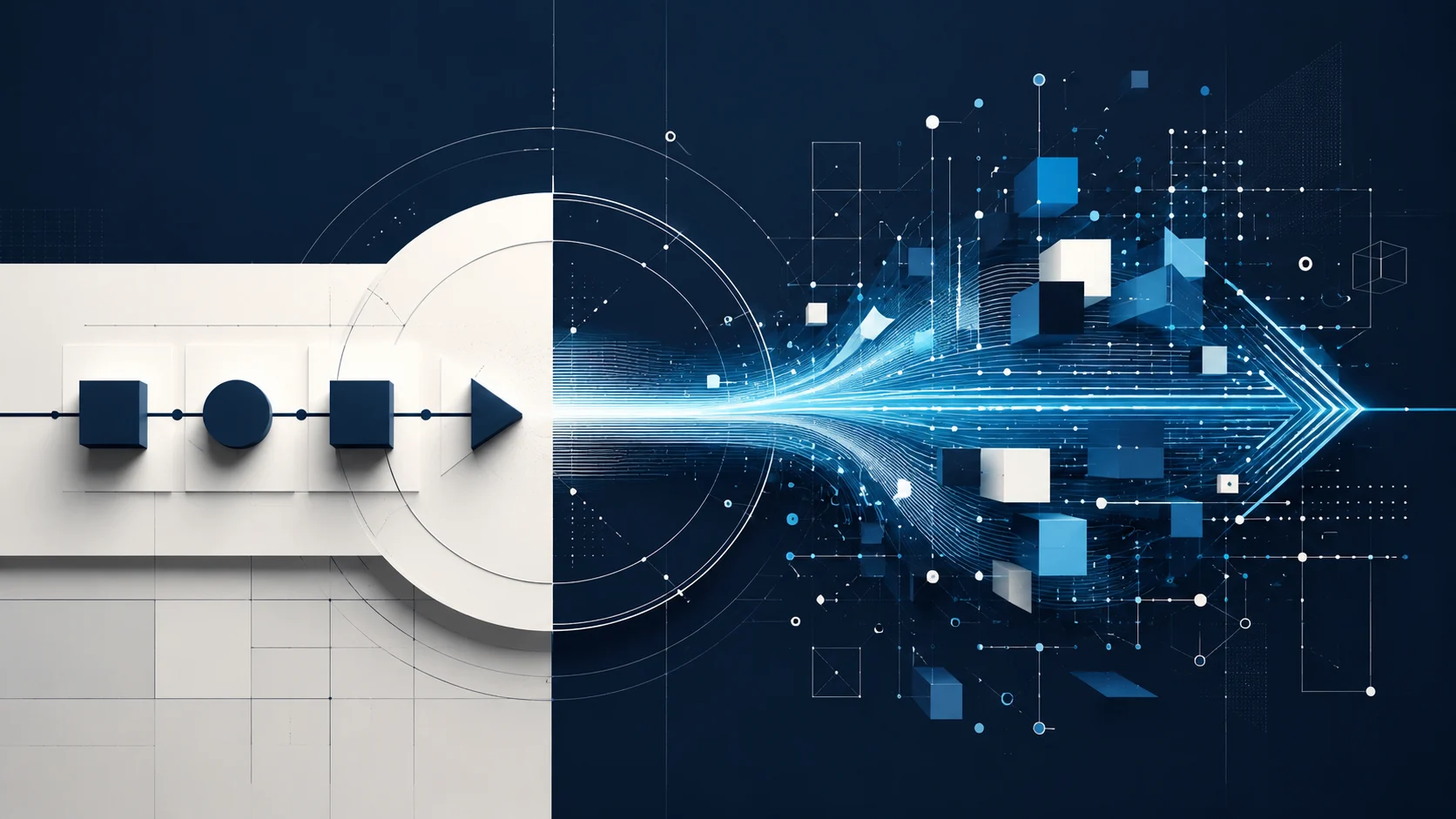
AI can automate, analyze, predict, and assist. But without a clear view of the system to improve, it mainly risks accelerating complexity and automating dysfunction. Lean gives it purpose: improving an understood flow.
The right order is therefore: understand and stabilize the process with Lean, then apply AI to amplify what already works.
02 · AI and Lean: detect, predict, assist, learn
Together, AI and Lean build systems that better detect problems, anticipate risks, assist teams, and learn continuously. Four complementary uses that structure this pillar.
AI does not replace the Lean system; it amplifies its detection and improvement loops where data volume exceeds human analysis.
03 · AI for project meetings
Project meetings concentrate coordination, decisions, and action tracking. AI can structure minutes, track commitments, and surface blockers, turning meeting time into reliable decisions.
The gain isn’t fewer meetings; it’s making each meeting more actionable: a clear record of what was decided and who does what.
04 · AI for planning
Planning coordinates participants, protects schedules, and anticipates risks. AI helps test scenarios, spot workload imbalances, and make commitments more reliable — supporting Lean methods (Last Planner System, pull planning).
It does not replace teams’ commitment to the plan; it sharpens it by making conflicts and float visible before they block.
05 · AI for constraint detection
Delays rarely come from a single issue; more often from undetected constraints, poorly identified dependencies, or information discovered too late. AI helps surface them early.
Detect constraints upstream so you can remove them before they turn into costly on-site blockages.
06 · AI for knowledge capitalization
Organizations already hold a vast amount of knowledge — lessons learned, minutes, decisions — often scattered and hard to find. AI helps make it accessible and reusable.
When well capitalized, this knowledge becomes an asset: you avoid relearning the same lessons and speed up good decisions.
07 · AI governance: confidentiality, human oversight, and trust
AI can improve analysis, coordination, and decision-making, but it requires clear governance: data confidentiality, human oversight, and trust. Without that, gains come with risks.
Lean’s approach to governance stays pragmatic: start from the problem, control the data, keep humans in the loop, and standardize what works.
08 · Why automating a bad process accelerates disorder
Automation improves speed and throughput — but applied to a poorly designed process, it also accelerates disorder. You replicate existing dysfunctions faster and at greater scale.
Hence the rule: improve the process first, then automate. That is exactly what Lean brings to any AI initiative.
09 · Metrics to track
Useful AI is managed by its real contribution to the system, not by the number of tools deployed:
- Issues detected earlier thanks to AI (constraints, deviations)
- More reliable decisions in meetings and planning
- Time freed up from low-value tasks
- Knowledge reused (effective capitalization)
- Human oversight and governance compliance
- Processes improved before automation
10 · Frequently asked questions
Should we do Lean before AI?
Yes—the logical order. Lean clarifies and stabilizes the process; AI then amplifies what works. Applied to a fuzzy process, AI mainly accelerates disorder.
Will AI replace teams?
In this approach, no: AI detects, predicts, and assists, but decision-making and improvement remain human. Human oversight is part of governance.
Which initial use cases have the highest ROI?
Often constraint detection, support for project meetings, and knowledge capitalization: high-leverage uses on data already available.
How do we retain control of the data?
Through explicit governance: confidentiality, data scope, human oversight, and traceability. That is the condition for trust and sustainable adoption.
Is automation always a good idea?
No. Automating a bad process reproduces its defects faster. First improve the process, then automate what truly creates value.
Go deeper
Explore each topic in this pillar with the Hub’s dedicated articles:
AI and Lean
Detect, predict, assist, learn.
AI governance
Confidentiality, human oversight, and trust.
Understanding Lean
The prerequisite: a system understood before being augmented.
Lean Construction
Collaborative planning and constraints: an ideal ground for AI.
A practical offer to get started
AI creates value when it serves an already-understood system. That’s why combining it with Lean matters.
Explore our offerings →