01 · What is Lean Construction?
Lean Construction applies Lean principles to construction and complex projects. It considers that a jobsite is not a simple sequence of tasks, but a system of production, coordination, and collaboration to be made more stable, more predictable, and higher-performing.
Rather than controlling tasks after the fact, it acts on how the project system actually runs: flow continuity, reliable commitments, constraint management, and fewer interruptions and waste.
03 · Lean Project Delivery (LPD)
Lean Project Delivery is the project's operating system: a holistic framework that integrates value definition, collaborative design, pull planning, production reliability, and continuous improvement.
Where conventional approaches add control and reporting to treat symptoms, LPD improves the quality of the production system itself and the project's operational stability.
04 · Pull Planning: schedule backward from milestones
Pull Planning builds the schedule backward, starting from the milestones to be achieved rather than pushing tasks top-down. Each party states what it needs to succeed with its work.
Milestones become true coordination tools: dependencies are clarified, constraints surface early, and commitments become more reliable.
05 · Last Planner System®: from plan to promise
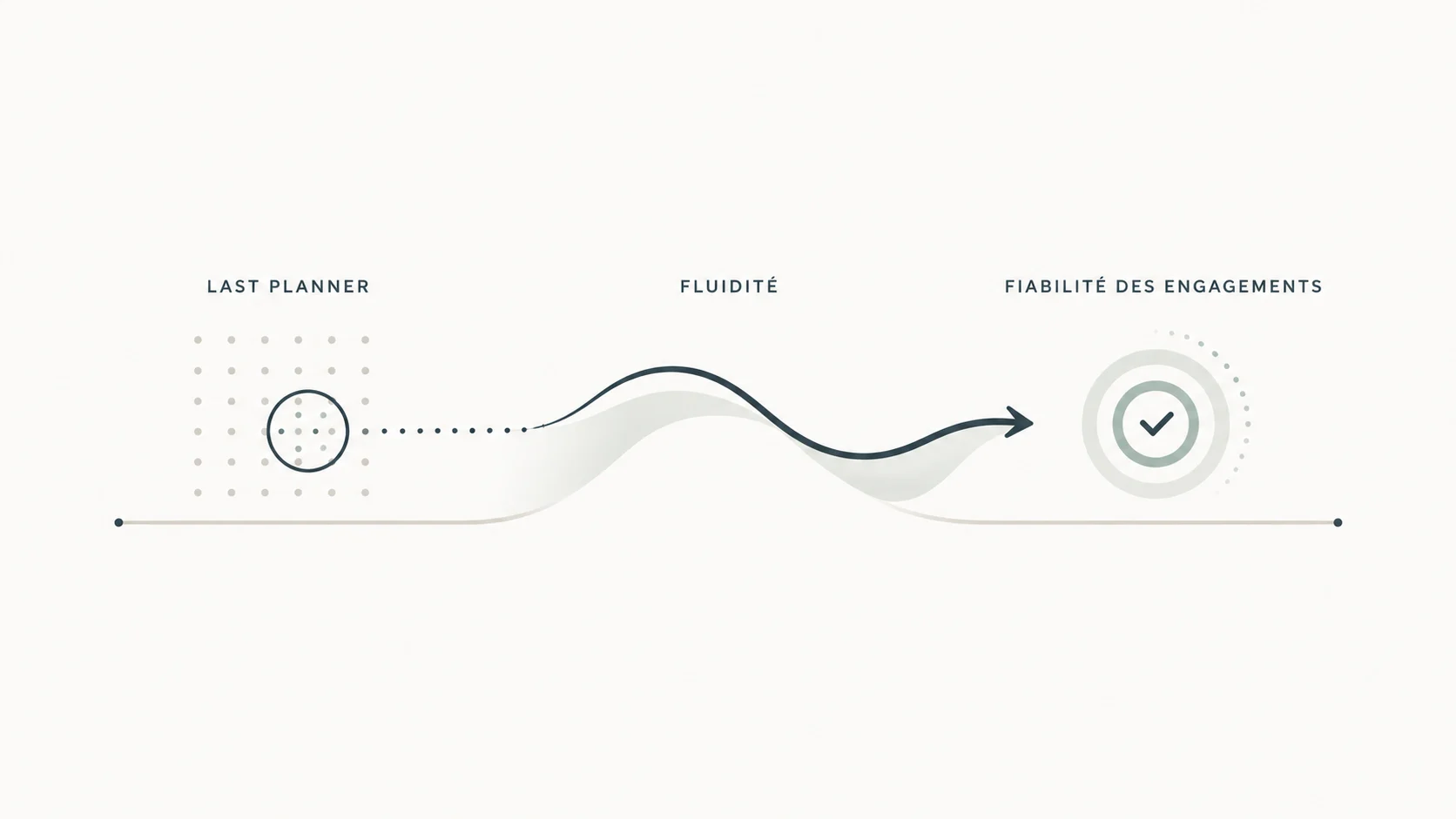
The Last Planner System® delivers schedules that are actually met through reliable commitments made by field teams. It articulates four levels: what should be done (master schedule), what can be done (constraints removed), what we commit to do, and what was completed.
A task whose prerequisites are not in place is not started. Variances are analyzed to learn, not to punish.
06 · PPC: measuring the reliability of promises
The PPC (Percent Promises Completed) measures the percentage of planned tasks actually completed as planned, typically daily or weekly. It does not answer “are we ahead or behind?” but “are we able to keep our commitments?”.
A project is nothing but a network of promises. The more reliable they are, the more reliable and optimizable the project.
It is a system health indicator, not a tool for individual sanction. Its real value lies in analyzing the causes of non-completion.
07 · Project constraints: make them visible before they block
In complex projects, delays rarely stem from lack of effort, but from constraints discovered too late: missing information, approvals not obtained, areas not ready, resources unavailable, interfaces not stabilized, shifting decisions.
Lean makes these constraints visible several weeks in advance — via visual management and collaborative reviews — and addresses them before they reach the field. An activity is started only when its conditions of readiness are met.
08 · Project flow: the real accelerator
In a project, whether in design or on site, dysfunctions come mainly from interruptions, waiting, and desynchronization, not from lack of activity. Accelerating is therefore not about “pushing” teams, but about making the flow more continuous.
Reduce batch sizes, stabilize zones, synchronize trades, and level the workload: it is flow, not instantaneous speed, that sustainably shortens timelines.
09 · Metrics to track
In Lean Construction, metrics are used to steer the stability and flow of the project system, not to grade individuals:
- PPC (Percent Plan Complete) — reliability of weekly commitments
- Constraints removed — count and average resolution time
- Causes of non-completion — recurrences to address at the root
- Milestone adherence and schedule variability
- Flow interruptions and waiting time
- Rework rate and stability of work areas
- Projected lead on milestones
10 · FAQ
Does Lean Construction replace MS Project or Primavera?
No. It complements traditional planning tools by improving real operational reliability: task make-ready, constraint management, and reliable field commitments. Tools such as P6 or others are useful for evaluations, simulations, and predesign phases. They are not project production management tools.
How is it different from traditional project management?
Traditional project management seeks to execute and control a predefined plan, whereas Lean Project Delivery organizes collaboration to maximize value, make commitments reliable, and continuously adapt execution to the realities of the project.
Is it only for large projects?
No. The principles apply to buildings, infrastructure, industrial projects, renovations, as well as smaller projects.
What is a “good” PPC?
It depends on the context. What matters is not an absolute number but continuous improvement and learning from the causes of non-completion.
Does improving flow really shorten schedule?
Yes. Interruptions and waiting account for a major share of performance losses. A more continuous flow shortens timelines while easing teams’ workload and reducing errors.
Further reading
Explore each topic in this pillar in the Hub’s dedicated articles:
Last Planner System®
From theoretical plans to reliable commitments.
Project constraints
Make them visible before they block.
Understand Lean
The fundamentals: value, flow, pull, respect, improvement.
Value, design & IPD
Design to value and align stakeholders.
An offering to take action
Lean project acceleration stabilizes operations and improves the reliability of field commitments on your complex projects.
Discover our offerings →